
Professor Michael Roberts – The King’s Birthday 2026 Honours List
ASCEPT would like to extend our congratulations to Professor Michael Roberts who was awarded an Officer of the Order of Australia (AO) in this year’s Kings birthday Honours.
“For distinguished service to pharmaceutical science and medicine, to the advancement of topical drug delivery, and to clinical toxicology research.
Mike Roberts has been a member of ASCEPT since 1971 and, looking back, many of the most important influences on his career came through the people, ideas, challenges and friendships encountered through the Society.
His interest in research began as an undergraduate pharmacy student, first through a fascination with the extemporaneous dispensing of creams and then through an undergraduate research elective which demonstrated reduced efficacy of certain drugs and excipients following uptake into and/or permeation through plastic ophthalmic containers during sterilisation by autoclaving. The work resulted in his first publication and sparked a lifelong interest in how drug structure influences permeability, pharmacokinetics, efficacy and toxicity. One important later outcome was the demonstration that nitroglycerin and many other drugs could be taken up by intravenous plastic giving sets, resulting in reduced drug delivery, a problem that he showed could often be avoided through the use of alternative plastics or reformulation.
As pointed out in his ASCEPT Rand Lecture in 2007, two patients during his Royal Adelaide Hospital internship proved particularly influential.
The first was an elderly patient receiving unusually large quantities of an expensive topical corticosteroid. Pharmacy was asked to investigate why the treatment costs were so high. The answer proved fascinating. The patient had initially presented with hiccups and was prescribed what was then considered the best available treatment. When an allergic reaction developed, the best available treatment for that reaction was prescribed. The patient subsequently became distressed and was prescribed the best available treatment for that problem. Eventually he developed a widespread skin eruption requiring large amounts of topical drug (corticosteroid) therapy. What intrigued Mike was that the medicines involved all shared the same phenothiazine core structure.
The experience taught him that the clinical pharmacist is the pharmaceutical scientist at the bedside, bringing together an understanding of drug structure, pharmacology, toxicity and topical drug (corticosteroid) therapy to improve patient outcomes. Looking back, the case foreshadowed two themes that would later underpin much of his career: clinical toxicology and topical drug delivery.
The second formative patient involved the management of a prisoner who had ingested a pesticide. At the time, the principal treatment available was supportive care. The question of whether there might be better ways to understand and manage poisoning sparked an enduring interest in clinical toxicology.
These experiences led him to Sydney University, where he was supported as a Pharmacy Tutor and completed postgraduate studies in clinical pharmacy, pharmacology and pharmacokinetics. It was a special period, bringing together some of the brightest pharmacists and scientists from around Australia and exposing them to visiting international leaders in drug absorption, pharmacokinetics and therapeutics. The overarching theme that emerged from this period was an interest in drug structure–pharmacokinetic–efficacy–toxicity relationships.
One of the great strengths of ASCEPT has always been the willingness of colleagues to challenge and inspire one another. Mike still recalls Felix Bochner’s observation that his move from Hobart to Dunedin appeared to be a journey from “nowhere to nowhere”. In the end, Mike’s own journey followed a remarkably similar path to Felix’s, ultimately taking him to Brisbane where Felix began his academic career and then to Adelaide where Felix later became Professor of Clinical Pharmacology.
Another memorable influence came from the elegant work of Richard Day and the late Gary Graham, who demonstrated how food could markedly delay the absorption of enteric-coated aspirin. The findings were so striking that Mike adapted them into undergraduate laboratory studies in which students prepared aspirin formulations, swallowed them and monitored their own urinary salicylate excretion. Such practicals would be impossible in today’s much more regulated ethical environment.
This work subsequently stimulated studies on aspirin, conducted with rheumatologist Peter Brooks and the late research student Roger Rumble, examining its efficacy in volunteers and patients with rheumatoid arthritis. They demonstrated induction of aspirin metabolism during repeated dosing that may explain the development of tolerance observed in some patients.
His years in Tasmania reinforced the value of working across disciplines and focusing on local problems. Research ranged from Huntington’s disease and hydatid disease to cardiac failure, rheumatoid arthritis and pharmacy competency. The latter work underpinned later aged-care initiatives that contributed, in part, to national funding of the Pharmacy Quality Care Program, Residential Medication Management Reviews, Home Medicines Reviews and dose administration aids.
Particularly memorable were studies in patients with Multiple Endocrine Neoplasia, where methylene blue was used to selectively identify abnormal parathyroid tissue during surgery. Looking back, these studies foreshadowed a lifelong interest in selective uptake, tissue targeting and the use of dyes and drugs to distinguish diseased from normal tissue.
During this period his group also co-developed the controlled-release aspirin product Cartia, a product still widely used today and one that was prescribed for Mike himself following a recent cardiac stent.
A sabbatical with Malcolm Rowland in Manchester proved particularly influential. Challenged to explain whether the well-stirred or tube model best described hepatic clearance, Mike spent months wrestling with the problem before realising that the answer lay in understanding drug distribution within the liver. The resulting work contributed to development of the physiologically based convection-dispersion model. This framework subsequently underpinned pre- and post-doctoral studies undertaken by many ASCEPT members and their students.
At the age of 35, Mike moved to New Zealand as Professor and Head of Pharmacy at the University of Otago, where he worked closely the NZHPA, Otago pharmacy and pharmacology staff, and with NZ ASCEPT clinical pharmacology colleagues, including Nick Holford, Carl Burgess and Evan Begg, to develop first postgraduate clinical pharmacy programs in the region. The late Garth McQueen, a distinguished clinical pharmacologist, founding ASCEPT committee member, and the namesake of ASCEPT’s Oral Communication Prize, was a volunteer and collaborator in studies concerned with the kinetics and clinical utility of subcutaneous compared to intravenous rehydration of the elderly. Nick both taught participants and coordinated the Auckland clinical pharmacy teleconferences. One of their discussions at that time was MKModel, one of the most sophisticated popPK programs at that time. A key discussion point was the balance between sophisticated outcomes and biological and clinical reality. Mike continues to hold the view that it is better to be approximately right and understand why than to be precisely wrong.
Returning to Queensland through a Lions Medical Research Foundation Fellowship at Princess Alexandra Hospital nurtured by Susan Pond was a significant gamble, exchanging a tenured professorship for a five-year research appointment. Looking back, it was one of the best decisions he ever made.
The Queensland years brought opportunities in topical drug delivery, aged-care medicines, targeted cancer therapy, liver disease, sepsis and clinical toxicology. Collaborative research contributed to government-supported medicines management programs in aged care, advances in topical anti-inflammatory therapy, improvements in sepsis management and research that was ultimately drawn upon by the US FDA in the development of sunscreen and topical product guidelines.
The Adelaide years provided a backdrop for the collaborations with Andrew Dawson, Nick Buckley, Geoff Isbister, Darren Roberts and other members of their clinical toxicology research network and Mike’s contribution to studies of poisoning, antidotes, toxicokinetics and patient management, as well as continued work in topical drug delivery.
Throughout this journey, ASCEPT remained a constant professional home. Research findings were presented, challenged and refined at annual meetings. Collaborations were formed, students were encouraged and lifelong friendships developed. Mike served as an ASCEPT Councillor, received the Michael Rand Medal in 2007 and was elected an ASCEPT Fellow in 2023.
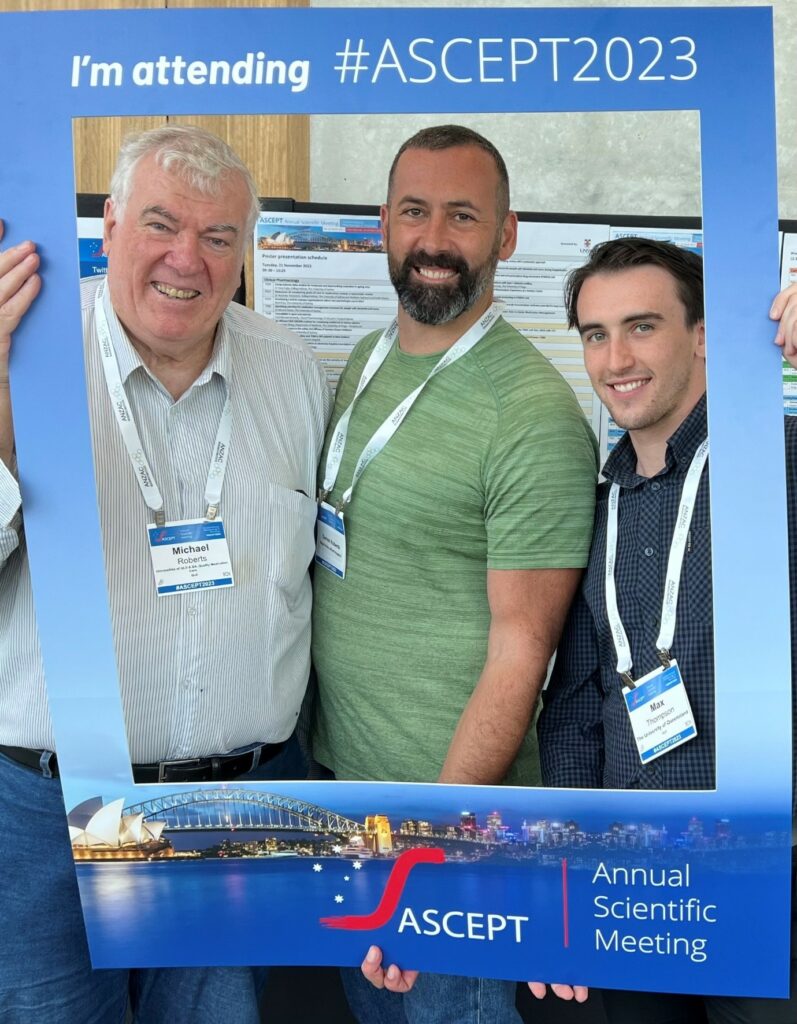
That Fellowship meeting was memorable for another reason. For the first time, three generations of the Roberts family attended together. The photograph from that meeting shows Mike, his eldest son Darren Roberts, pharmacist, physician, clinical pharmacologist and clinical toxicologist, and his grandson Maxwell Roberts Thomson, pharmacist, then presenting his own clinical pharmacokinetic research and now studying medicine. For Mike, it was a powerful reminder that science is ultimately about people, mentorship and the passing of ideas from one generation to the next.
Reflecting on more than five decades with ASCEPT, Mike regards the Society not simply as a professional organisation but as a community that helped shape his scientific thinking, his career and many enduring friendships. The appointment as an Officer of the Order of Australia may recognise individual contributions, but it also reflects the influence of the many colleagues, mentors, students and collaborators who shared the journey.
Professor Michael Roberts – The King’s Birthday 2026 Honours List
ASCEPT would like to extend our congratulations to Professor Michael Roberts who was awarded an Officer of the Order of Australia (AO) in this year’s Kings birthday Honours.
“For distinguished service to pharmaceutical science and medicine, to the advancement of topical drug delivery, and to clinical toxicology research.”
